Who Is the Artist That First Invented This Character Used in Most Day of the Dead Art?â€
In Mexico on November 2, mortality is approached with music and laughter.
"On the Day of the Dead, when the spirits come dorsum to us," explains the Dr. Vigil character in the 1984 film of Malcolm Lowry's Under the Volcano, "the road from heaven must be fabricated easy, and not slippery with tears."
The souls of the dead are welcomed dorsum with offerings of food and drink. Skulls and frolicking skeletons, often dressed in total costume, are depicted on alters, food and elsewhere — a playful reminder that all of united states, despite our vanities, will one 24-hour interval turn to dust.
The origins of the Solar day of the Dead and its basic motifs can exist traced back 3000 years, to the Aztecs, only the satirical skeletons of its nowadays-24-hour interval iconography bear the strong influence of one human being who died 101 years ago: the printmaker and draughtsman José Guadalupe Posada.
Posada was an obscure newspaper illustrator when he settled in Mexico Urban center in 1888 and began working for a company that published graphic flyers designed to bring the news of the day to a largely illiterate public. Posada's engravings soon caught on.
"Long drawn to the sensational," writes Jesse Cordes Selbin at the Henry Ransom Center, "Posada'southward involvement centered on such fantastic and unsavory aspects of life as murders, robberies, bullfights, political scandals, and illicit love affairs. While his political work alternately satirized President Porfirio Díaz and lauded the populist revolutionary leaders Emiliano Zapata and Francisco Madero, for the nigh part his prints successfully struck the fine line betwixt difficult-hitting and calorie-free-hearted, resonating widely throughout United mexican states."
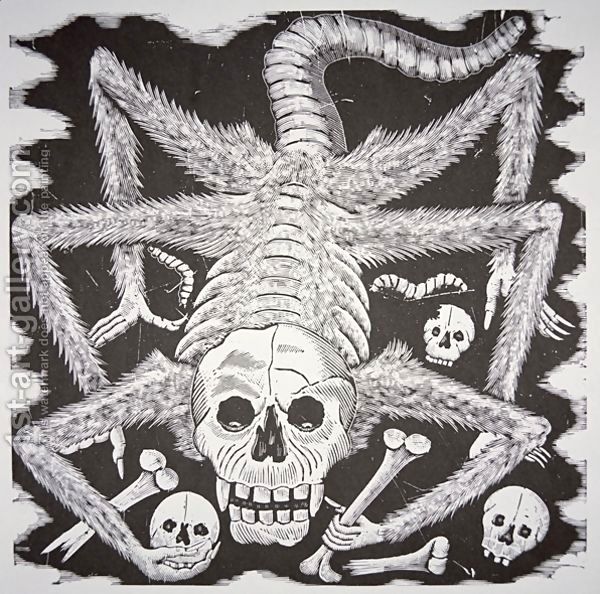
Despite their humble purpose, Posada'south engravings were a major influence on the development of 20th century Mexican fine art. Octavio Paz described his technique equally "a minimum of lines and a maximum of expression." In his introduction to Mexico: Splendors of 30 Centuries, Paz writes, "By birthright Posada belongs to a manner that has left its stamp on the twentieth century: Expressionism. Unlike the majority of Expressionist artists, even so, Posada never took himself besides seriously."
Others, however, did. The muralists who flourished in post-revolutionary United mexican states revered Posada. Diego Rivera and José Clemente Orozco, in particular, praised him as an inspirational figure. In his autobiography, Orozco writes:
Posada used to work in full view, behind the shop windows, and on my mode to school and back, iv times a day, I would terminate and spend a few enchanted minutes in watching him, and sometimes I even ventured to enter the shop and snatch upwards a flake of the metal shavings that roughshod from the minimum-coated metallic plate as the master's graver passed over it. This was the push button that start set my imagination in motion and impelled me to cover paper with my primeval little figures; this was my awakening to the existence of the art of painting.
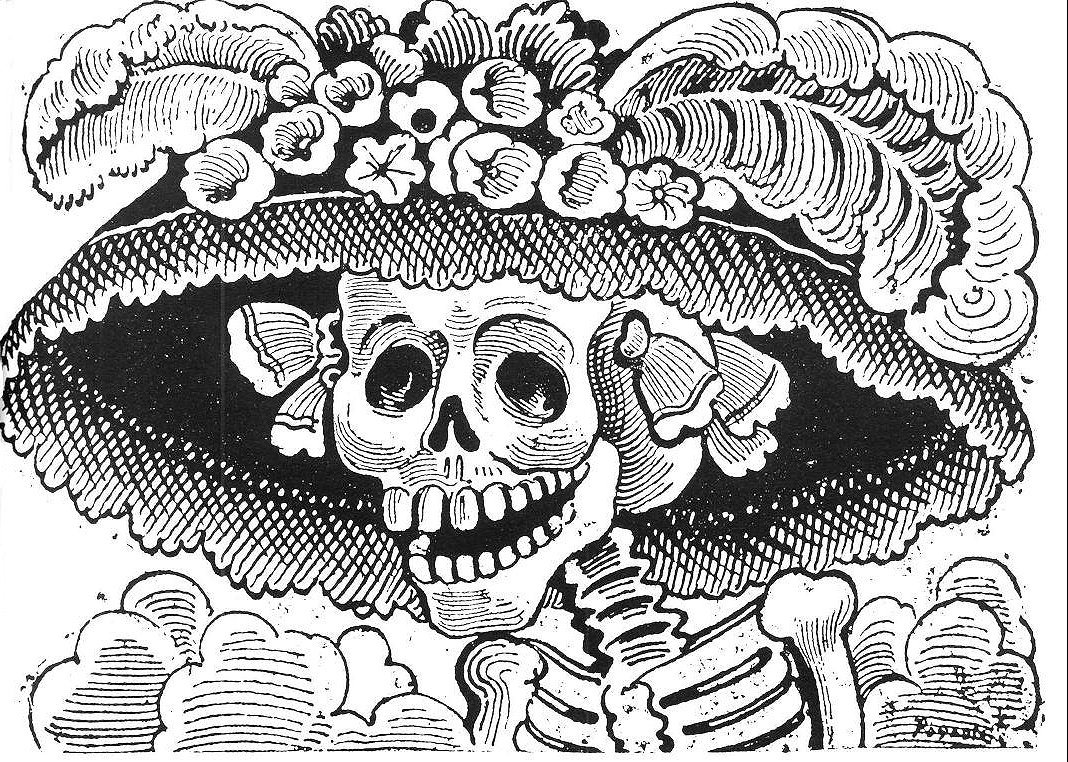
The most influential of Posada'due south works were his Calaveras, significant "skulls," or, by extension, "skeletons." Peradventure the most famous work from the series is Calavera Catrina (in a higher place), a zinc etching completed in virtually 1910. Information technology depicts a womanof the social class known as theCatrins (from a Spanish word meaning "over-elegant"), a group who denied their Maya heritage and thought of themselves only as European.
In 1947 Diego Rivera paid homage to Posada by placing him at the center of his panoramic Dream of a Sunday Afternoon in the Alameda Central with a total-length version of the Calavera Catrina on his arm, while Rivera himself, depicted as a young boy, stands on the other side holding her bony paw. For more of Posada'southward Calaveras, scroll down.
The Folk Dance Beyond the Grave:
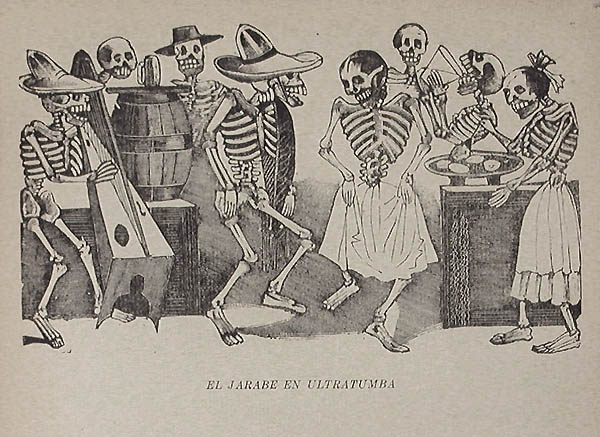
Some other zinc etching from around 1910, El Jarabe en ultratumba ("The Folk Dance Beyond the Grave") depicts a merry group of skeletons eating, drinking, making music and dancing the traditional jarabe. The reproduction is from the posthumous 1930 monograph Las Obras de José Guadalupe Posada, Grabador Mexicano.
Calavera from Oaxaca:
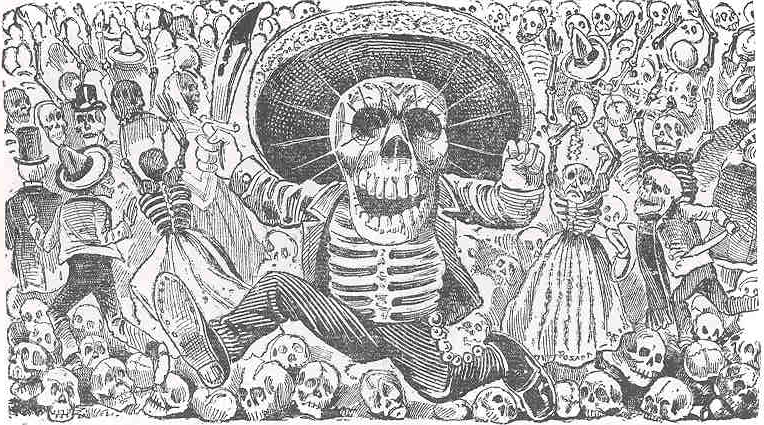
Calavera Oaxaqueña ("Calavera from Oaxaca") was first published on a broadside in 1910. Information technology shows a proud-looking skeleton dressed as a charro, running past a crowd of skeletons with a blood-stained knife in his hand.
Calavera of Don Quixote:
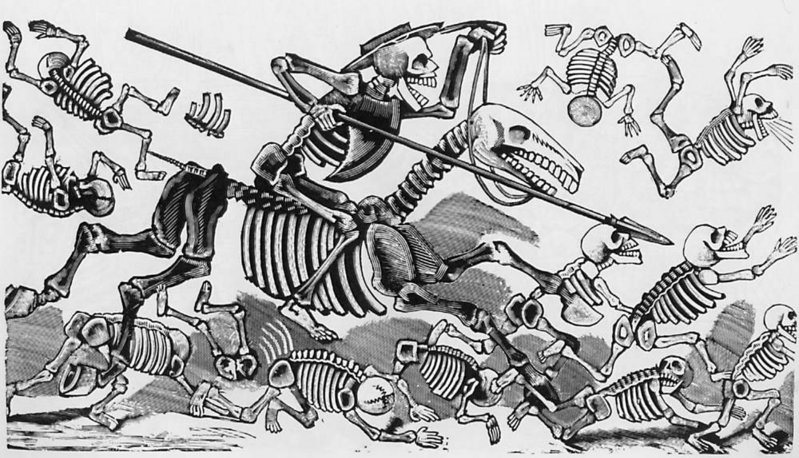
In this etching made sometime betwixt 1910 and Posada'due south death in 1913, Don Quixote rides into battle wearing an upside-downward hairdresser's basin he imagines to be the legendary helmet of Mambrino, a solid-gilt relic said to brand its wearer invulnerable. He vanquishes every foe. "This is the calavera of Don Quixote," says the caption on the original broadside publication, "the first-class one, the matchless i, the gigantic 1."
Click on the images above to view them in a larger format. You can view more prints by Posada at MoMA and The Public Domain Review.
Related Content:
Charles & Ray Eames' Short Picture show on the Mexican Day of the Expressionless (1957)
Frida Kahlo and Diego Rivera Visit Leon Trotsky in Mexico, 1938
Speaking in Whistles: The Whistled Language of Oaxaca, Mexico
Source: https://www.openculture.com/2014/11/the-classic-skeleton-art-of-jose-guadalupe-posada.html
0 Response to "Who Is the Artist That First Invented This Character Used in Most Day of the Dead Art?â€"
Post a Comment